What Your Check Engine Light Is Trying to Tell You
The light is a message from your car's computer, and reading it correctly starts with whether it's steady or blinking.
October 14, 2026 · 4 min read
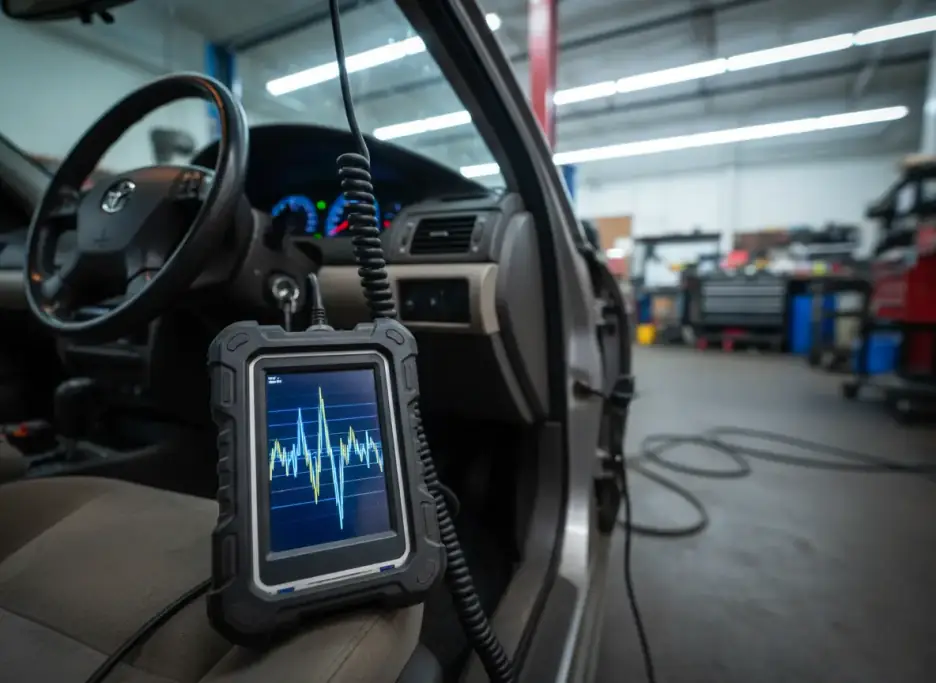
It usually shows up on a Tuesday morning, halfway to work, when you have exactly zero time to deal with it. A small amber engine icon lights up on the dash, the car seems to drive just fine, and you have to decide whether to ignore it, panic, or put a piece of tape over it. None of those is the right move. The light is your car's way of saying its computer has noticed something outside the normal range. What it noticed, and how urgent that is, depends on a few things you can figure out in about a minute.
Solid or flashing: start here
A steady light means the computer has logged a fault and wants it looked at soon. You don't need to pull over on the spot, but you shouldn't forget about it either. Plan to get it checked in the next few days, and pay attention to how the car feels in the meantime.
A flashing light is different. It usually signals an active engine misfire, which means fuel isn't burning properly in one or more cylinders. Unburned fuel can pass into the exhaust and overheat the catalytic converter, and that's a part you really don't want to damage. If the light is flashing, ease off the throttle, avoid hard acceleration and towing, and get the car to a shop as soon as you safely can. If it's also shaking badly, running rough or losing power, stop driving it and call for a tow.
The usual suspects
Hundreds of different faults can trigger the light, but a short list covers a lot of the cases we see on cars and trucks. Here are some of the most common.
- A loose or worn gas cap, which lets fuel vapor escape and trips the evaporative emissions monitor.
- A failing oxygen sensor, which can throw off the fuel mixture and hurt gas mileage over time.
- Worn spark plugs or failing ignition coils, a common source of misfires.
- A dirty or failing mass airflow sensor that is feeding the computer bad information about how much air the engine takes in.
- A vacuum leak from a cracked hose or a loose fitting, which can cause a rough idle.
- A catalytic converter that isn't doing its job, often as a result of some earlier problem that was ignored.
- Sensor trouble involving the crankshaft, camshaft or coolant temperature, which can affect starting and idle.
Notice how different those are. Some are a thirty second fix and some are a real repair. That's exactly why the light alone can't tell you what to do.
What a code reader tells you, and what it doesn't
Plenty of parts stores will read the code for free, and that can be a handy first step. But a code is a starting point, not a diagnosis. A code that points to a misfire in cylinder three, for example, tells you where the computer noticed the symptom. It doesn't tell you whether the cause is a spark plug, a coil, a fuel injector, a vacuum leak or a mechanical problem inside the engine. Replacing parts based on a code alone is how people end up with a new part, the same light, and a lighter wallet.
Real diagnosis means reading the code, then looking at live data, checking the related systems, and testing the suspect part before anyone replaces it. The code narrows the search. The testing finds the answer.
A few things to check before you call
If the light is steady and the car is driving normally, there are two easy checks. First, make sure the gas cap is on and clicked tight. If it was loose, the light can take a few drives to reset after you tighten it. Second, think about whether anything changed recently: a fill-up at an unfamiliar station, a stretch of heavy rain or a big temperature swing, or a new noise. Any of that is worth passing along, because details like these help a technician narrow things down faster.
Why waiting tends to make it worse
A small fault that goes unaddressed doesn't always stay small. A weak sensor can make an engine run rich or lean, which strains other parts. A minor misfire can turn into a damaged converter. And a steady light that you've been ignoring also hides the next problem: if the light is already on, you won't notice when a second fault joins it. Early attention keeps repairs simpler.
How we approach it
Computer diagnostics is one of the services we do every day at Ultimate Automotive Service Center. We look at engine, chassis and transmission data, including ABS brake problems, and we work on older vehicles that pre-date onboard computers as well as newer ones. Vehicle programming is available when a repair calls for it. We'll explain what we find in plain terms before any repair begins, so you know what's going on with your car.
We're at 5900 Oakwood Drive in Urbandale, open 7 AM six days a week and until 9 PM on weeknights, which helps if the light came on during the workday. Call (515) 270-2096 and we'll find a time to take a look. If the light is flashing or the car is running rough, tell us when you call so we can plan around it.
Ultimate Automotive Service Center, (515) 270-2096
Call (515) 270-2096More articles
Why Tire Tread Matters More in Rain and Snow
The grooves in your tires do real work every time the road gets wet, and they run out sooner than most drivers think.
Brake Warning Signs Iowa Drivers Should Not Ignore
Brakes almost always warn you before they fail, if you know what to listen and feel for.